


Mobile monetization is tough for some publishers, especially the ones that come from a web background.
Most seasoned webmasters are used to signing ad deals with top networks, inserting a couple of codes on their website or in their ad server, and then optimize to deliver the one(s) that yield the highest eCPM.
Mobile on the other hand has brought a new challenge. Many traditional advertisers don’t see the same return in mobile traffic, hence end up blocking it from their ad-buys, reducing the eCPM paid out to the publisher.
Over the last five years, we’ve seen a tremendous increase in Interstitial advertisements.
These creatives overlay the entire page of a mobile website yielding the advertiser a very high click through rate (CTR) and earning the publisher much highest eCPMs:

As you probably can see, this works exceptionally well for performance marketers as they’re able to leverage their high click through rates to achieve an ROI that is highly sustainable.
Unfortunately, Google announced last week, that effective January 10, 2017, pages where content is not easily accessible to an user will have their search engine rankings penalized.
Examples include:
- Showing a popup that covers the main content, either immediately after the user navigates to a page from the search results, or while they are looking through the page.
- Displaying a standalone interstitial that the user has to dismiss before accessing the main content.
- Using a layout where the above-the-fold portion of the page appears similar to a standalone interstitial, but the original content has been inlined underneath the fold.
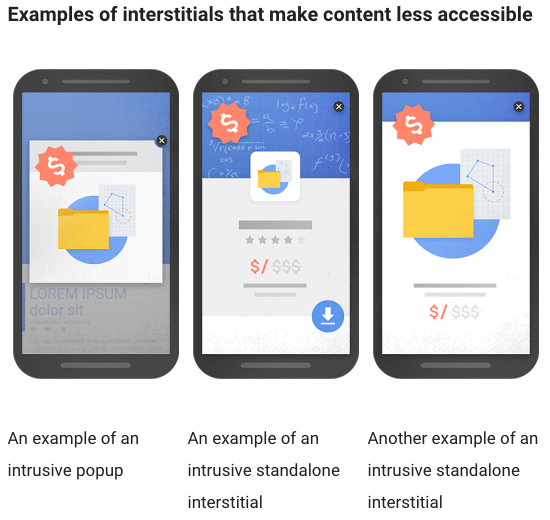
They will however, allow certain exceptions for websites that use these techniques “responsibly.”
These may include:
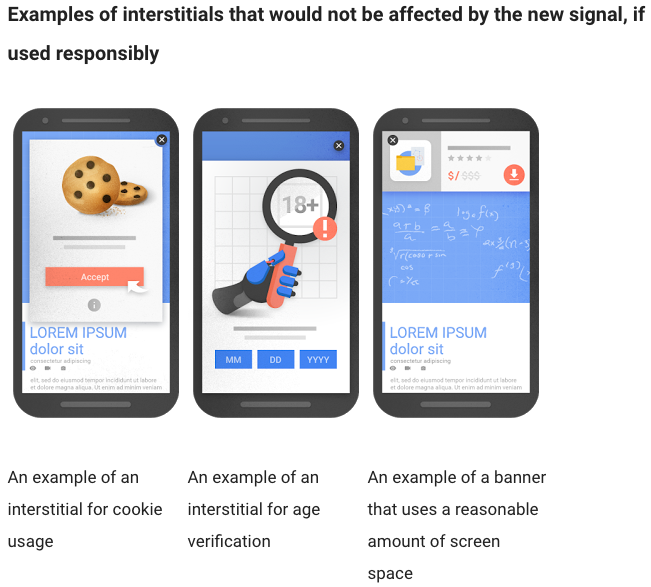
- Interstitials that appear to be in response to a legal obligation, such as for cookie usage or for age verification.
- Login dialogs on sites where content is not publicly indexable. For example, this would include private content such as email or unindexable content that is behind a paywall.
- Banners that use a reasonable amount of screen space and are easily dismissible. For example, the app install banners provided by Safari and Chrome are examples of banners that use a reasonable amount of screen space.
Google has a long history of penalizing “ad-heavy” websites in their search algorithm as they’re constantly looking to improve user experience.
While this is certainly isn’t ideal, I personally don’t see it having a tremendous effect on performance marketers.
In the short-term there maybe some decreased earnings or performance in interstitial creatives, but publishers and ad networks are still going to find other ways to maximize their mobile eCPMS.
We’ve used mobile interstitials very successfully for many years and we will continue to do so. A lot of publishers that use these units aren’t using Google as their main traffic source anyway. However, those that are, should begin testing alternate units before the deadline to protect their rankings.
Here at RevMax, we’ll continue to work with our publishers and help them utilize our technology to offer their end-users the best experience possible.

